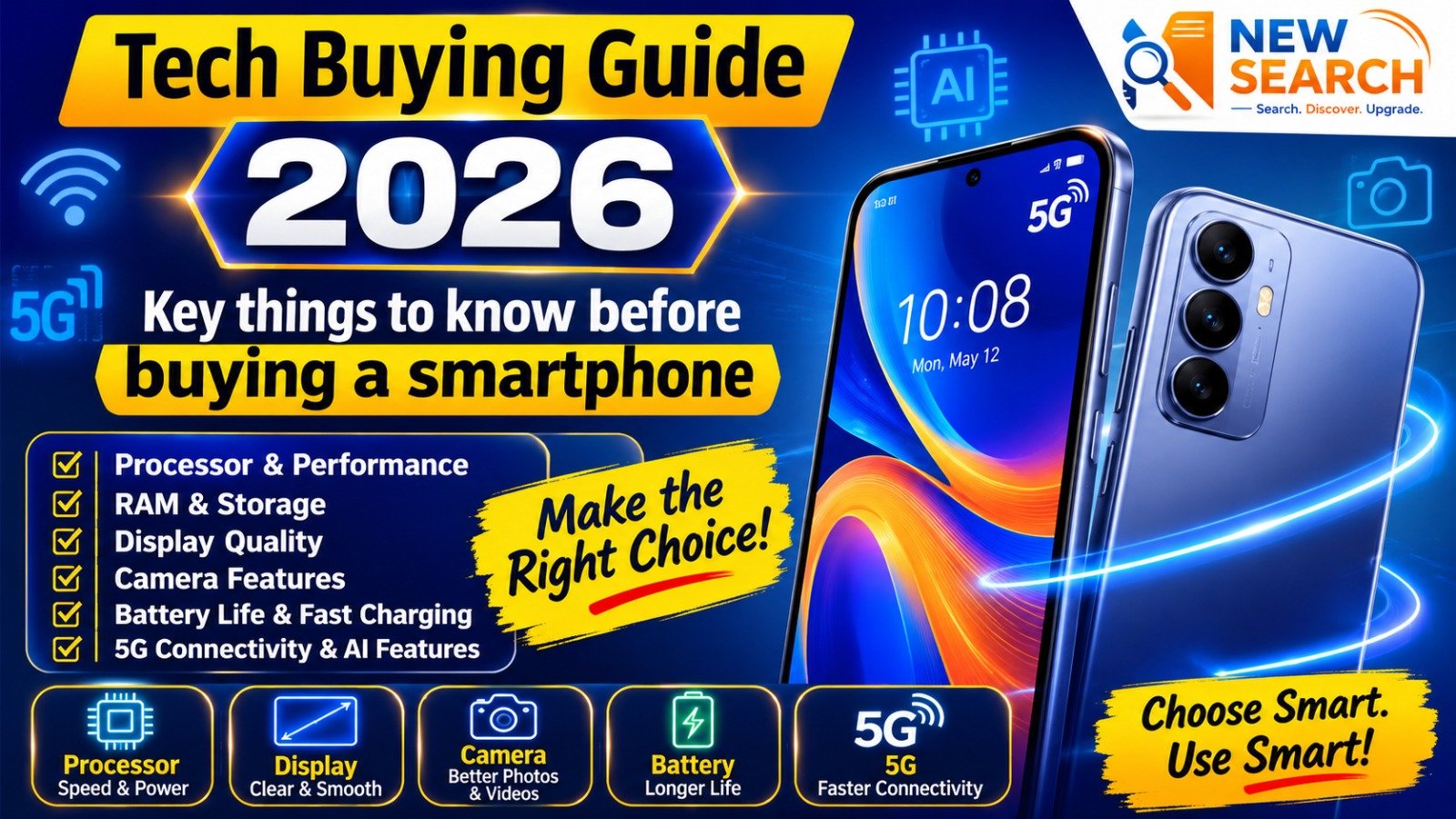
Tech Buying Guide 2026: Smartphones are no longer just tools for calling and messaging; they are used for photography, gaming, online payments, social media, video streaming, office work, content creation, and AI tools.
Therefore, before buying a smartphone, first determine what you intend to use the phone for.
If your usage is basic, you might not need an expensive flagship phone. Conversely, gaming or content creation may require more powerful hardware.
1. First, determine your smartphone budget
Setting a maximum budget is the most important step before buying a smartphone.
For example, if your budget is ₹20,000, you should focus on models available within that price range rather than comparing them to phones costing ₹25,000–₹30,000.
The actual cost of a smartphone isn’t limited to the phone’s price alone; consider the cost of the charger, case, screen protector, and other accessories as well.
When setting a budget, consider:
Final price of the smartphone
Bank/exchange offers
Charger availability
Warranty
Accessories
Repair costs
Long-term software support
Tip: Don’t buy a phone just because there is a huge discount. First, check if it meets your specific needs.
2. The processor is the most important part of a smartphone
The processor plays a major role in a smartphone’s speed and performance.
When choosing a processor, looking only at its name or core count isn’t enough. You should also consider real-world performance, gaming performance, power efficiency, and AI processing capabilities.
When choosing a processor, consider:
CPU performance
GPU performance
Power efficiency
AI processing
Thermal management
5G modem
Chipset generation
If you are into gaming, a powerful GPU and superior thermal management might be more important for you.
However, for general tasks like social media, calling, and browsing, a mid-range processor may suffice.
3. How much RAM do you need?
RAM affects a smartphone’s multitasking capabilities.
Having more RAM can help when using multiple apps simultaneously. However, simply having more RAM doesn’t guarantee that the smartphone will perform better in every situation. Software optimization and the processor also play a crucial role in performance.
A simple guide to choosing RAM:
Basic Use: Lower RAM may suffice for standard apps, calling, and browsing.
Heavy Multitasking: Higher RAM is beneficial for handling multiple apps and productivity tasks.
Gaming/Content Creation: A powerful processor and superior storage are essential alongside higher RAM.
4. Be careful when choosing storage
Nowadays, photos, videos, games, and apps on smartphones can consume a significant amount of storage space.
Therefore, when buying a phone, consider not just the storage capacity, but also the speed of the storage technology and whether there is an option to expand the storage.
When choosing storage, consider:
128GB
256GB
512GB
Storage Type
Expandable Storage
Cloud Storage Support
If you record a lot of 4K videos or play large games, a smartphone with higher storage capacity might be a better choice.
5. Don’t buy a display based solely on size
A smartphone’s display significantly impacts your daily user experience.
When buying a phone, be sure to check these features:
Display Size
Resolution
Refresh Rate
Peak Brightness
HDR Support
Panel Technology
Touch Sampling/Response
Screen Protection
If you are into gaming, a high refresh rate and good touch response can be very useful.
On the other hand, for those who watch movies and videos, brightness, contrast, and color quality are important factors.
6. Don’t look only at megapixels for the camera
The camera often receives the most attention when buying a smartphone. However, camera quality does not depend solely on megapixels.
Sensor quality, image processing, stabilization, and software play crucial roles in a good camera smartphone.
When evaluating the camera, look for:
Main Camera Sensor
OIS
Ultrawide Camera
Telephoto Camera
Night Photography
Portrait Mode
Video Recording
Image Processing
AI Camera Features
If you create videos for YouTube, Instagram, or other platforms, make sure to check for video stabilization, front camera quality, and microphone support.
7. Understand the difference between battery capacity and battery life
Many people buy smartphones based solely on the mAh rating. However, a large battery doesn’t always guarantee better battery life.
Battery backup is influenced by processor efficiency, the display, software optimization, and your usage patterns.
When considering the battery, look at
Battery Capacity
Charging Speed
Wired Charging
Wireless Charging
Whether a charger is included
Battery Health Features
If you travel all day or use your phone continuously, battery life might be even more important to you than the camera.
8. How important is fast charging?
Fast charging is available on many smartphones today and can help charge the battery very quickly in a short amount of time.
However, alongside charging speed, one should also consider charger compatibility and battery management.
When buying a phone, check the following
Whether the charger is included in the box
The charging speed supported by the phone
The cost of a compatible charger
How heat is managed during charging
9. What to look for when buying a 5G smartphone?
5G connectivity can be a crucial feature when buying a new smartphone in 2026.
However, do not buy a phone simply because it is labeled “5G.” Different smartphones support different 5G bands.
Also, check for
Supported 5G bands
4G compatibility
Wi-Fi
Bluetooth
NFC
GPS
USB Type-C
eSIM support
It is useful to check the supported bands based on your region and network provider.
10. How useful are AI smartphone features?
AI features in smartphones are rapidly increasing in 2026.
Many smartphones are utilizing AI for tasks such as photography, search, translation, writing, and productivity.
Examples of AI features:
AI photo editing
Object removal
AI writing
Live translation
Voice assistance
AI search
Photo enhancement
Summarization
Smart suggestions
However, do not be swayed solely by the “AI” label when buying a smartphone.
First, consider whether the provided AI features are actually useful for your daily usage.
11. Do not overlook software and updates
Software updates are crucial for the long-term value of a smartphone.
Check the company’s update policy before purchasing the phone.
Check
How many OS updates will be provided?
For how long will security updates be provided?
How frequently are updates released?
What is the company’s software interface like?
How many pre-installed apps are there?
If you intend to use the smartphone for 3–5 years, a phone with long-term software support may be more beneficial.
12. Consider build quality and durability
A smartphone is a device used daily; therefore, its build quality is also important. Pay attention to these aspects:
Frame Material
Back Panel
Screen Protection
Water/Dust Resistance
Weight
Thickness
Grip
If you intend to use the phone for a long time, it is advisable to prioritize models with a sturdy build and robust protection.
13. Privacy and Security Features
Smartphones contain our personal photos, messages, banking apps, and other important data.
Therefore, do not overlook security features.
Look for
Fingerprint Sensor
Face Unlock
Secure Lock System
Software Security Updates
App Permissions
Privacy Controls
Secure Payment Support
It is also important to understand the privacy settings available on the smartphone.
14. Audio and Connectivity Are Also Important
If you frequently listen to music or watch videos, audio quality can significantly enhance your experience.
Look for
Stereo Speakers
Speaker Quality
Bluetooth Audio Support
USB Type-C Audio
Headphone Jack
Microphone Quality
Content Creators
Microphone quality can be particularly important for content creators.
15. Buy only after reading reviews
Product reviews can be very helpful when shopping online.
However, do not make a decision based solely on a five-star rating.
Look specifically for these details in the reviews:
Battery performance
Heating issues
Camera quality
Software bugs
Gaming performance
Build quality
Network performance
Customer support
It is best to make a decision by considering both professional reviews and long-term user reviews.
16. Warranty and after-sales service
Make sure to read the warranty terms before buying a smartphone.
Check
How long is the warranty period?
Is there accidental damage coverage?
Where are the service centers located?
What is the cost of screen replacement?
What is the warranty for accessories?
If the specifications of two smartphones are nearly identical, the brand with the better service network might be the more practical choice.
17. Things to keep in mind when buying a smartphone online
You can often find better deals when shopping online, but before purchasing:
Check the seller rating
Read the return policy
Check warranty details
Verify the product model number
Check the final price
Read the conditions for bank offers
Understand the delivery and replacement policies
Do not make a purchase based solely on the discount percentage.
18. Should you buy a flagship smartphone?
A flagship smartphone is not necessary for everyone.
If you have a healthy budget and desire the best camera, premium build, high-end performance, advanced AI features, and long-term software support, then a flagship phone could be a great choice.
However, if your usage is limited to calling, social media, streaming, and casual photography, a mid-range smartphone can easily meet your needs.
The best smartphone is the one that strikes the right balance between your requirements and your budget. Smartphone Buying Checklist 2026
Be sure to check this list before buying a new smartphone
✅ Budget
✅ Processor
✅ RAM
✅ Storage
✅ Display
✅ Camera
✅ Battery
✅ Charging
✅ 5G Bands
✅ AI Features
✅ Software Updates
✅ Security
✅ Build Quality
✅ Speakers
✅ Connectivity
✅ Warranty
✅ Reviews
✅ After-Sales Service
✅ Price-to-Performance
Conclusion- According to the Tech Buying Guide 2026, focusing solely on camera megapixels, RAM, or discounts is not the right approach when buying a new smartphone. First, determine your needs and budget, then compare specifications like the processor, display, camera, battery, storage, software updates, AI features, and 5G connectivity.
If you are into gaming, prioritize performance and cooling. If you enjoy photography, look at the camera sensor and image processing capabilities. If you plan to use the phone for the long term, pay attention to software updates and battery health features.
Most importantly, the smartphone that is best for someone else may not necessarily be the best for you. Choose features based on your usage patterns and check reviews, warranty terms, and after-sales service before making a purchase.
By following this approach, you can select a smartphone within your budget in 2026 that remains useful to you not just today, but for years to come.

Tech Buying Guide 2026: Key things to know before buying a smartphone.
Also read– Welcome to NEW SEARCH